
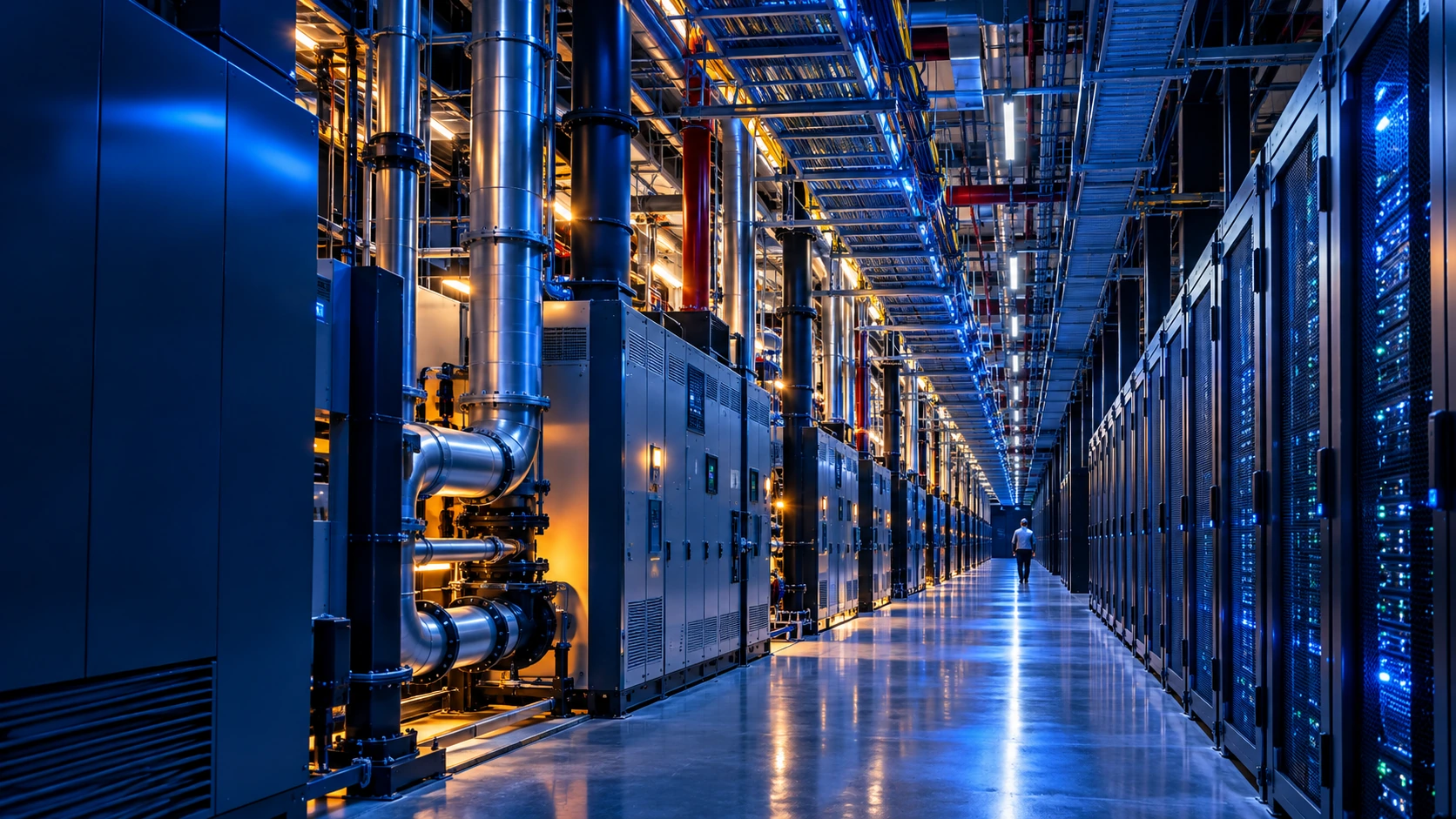
The International Energy Agency expects global data-center electricity consumption to nearly double from 485 TWh in 2025 to 950 TWh by 2030. The largest technology companies spent more than $400 billion in capital expenditure in 2025, with a further 75% increase projected for 2026.
But the companies supplying this expansion capture very different economics. Some generate measurable AI revenue today; others depend on broader electrical investment, long construction cycles, or the successful conversion of orders into cash.
Five companies illustrate where the opportunities—and the risks—diverge.
1. Broadcom (AVGO) — Custom AI Silicon
Broadcom offers major technology companies an alternative to relying exclusively on Nvidia GPUs through custom accelerators and networking chips.
In fiscal Q3 2026, AI semiconductor revenue reached $16.7 billion, up 221% year over year, accounting for approximately 56% of total quarterly revenue. Management expects $21.7 billion in AI semiconductor revenue in Q4.
Few infrastructure suppliers can demonstrate AI demand so directly. The vulnerability is concentration: large custom-chip programs depend on a limited number of major customers and their evolving hardware strategies.
What matters: Whether custom-silicon growth can sustain strong margins and cash flow as hyperscaler requirements change.
2. Arista Networks (ANET) — The Networking Layer
Larger AI clusters require increasingly sophisticated networking. Arista's high-performance Ethernet systems position it to benefit from that demand.
Q2 2026 revenue increased 37.7% to $3.04 billion, with a 49.9% non-GAAP operating margin (45.4% GAAP).
The distinction is that Arista's results include conventional cloud and enterprise networking—not just AI deployments. Its opportunity is substantial, but AI-specific adoption and customer concentration remain critical variables.
What matters: AI networking revenue opportunities, competitive positioning, and margin sustainability as new platforms scale.
3. Vertiv (VRT) — Cooling and Critical Power
As AI server densities increase, cooling efficiency and power reliability become central to data-center economics.
Vertiv reported 18% organic sales growth in Q2 2026, while adjusted operating margin rose 410 basis points to 22.6%.
This combination of underlying demand and improving profitability is encouraging. Yet expanding capacity, supply-chain constraints, and increasingly complex installations create execution risk.
What matters: Whether Vertiv can maintain margin expansion while converting large infrastructure projects into profitable, cash-generating revenue.
4. Eaton (ETN) — Electrical Distribution
AI facilities need switchgear, circuit protection, and power-distribution equipment. Eaton supplies these systems within a much broader industrial portfolio.
In Q2 2026, Electrical Americas generated approximately $4.0 billion in revenue, with 18% organic growth. Its 12-month rolling average of orders rose 41% organically, while backlog increased 33% year over year.
These figures signal strong electrical demand, but not all of it comes from AI. Eaton's diversification offers broader exposure to electrification while making its AI contribution harder to isolate.
What matters: Order-to-revenue conversion, electrical segment profitability, and the durability of spending beyond data centers.
5. Quanta Services (PWR) — Building the Grid
Computing capacity is only useful when sufficient electricity can reach the facility.
Quanta builds and maintains transmission, distribution, and related infrastructure. Q2 2026 revenue reached $9.56 billion, while total backlog stood at $53.4 billion, including $33.6 billion in remaining performance obligations.
Its exposure extends well beyond AI into utility investment and grid modernization. Moreover, Quanta's backlog is a non-GAAP measure that includes estimated future work; it should not be confused with guaranteed revenue or profit.
What matters: Project execution, skilled-labor capacity, backlog quality, and free-cash-flow conversion.
The Investment Question
These five companies represent different stages of the same infrastructure buildout—from computing and networking to cooling, electrical distribution, and grid construction.
Their financial indicators are not interchangeable. Broadcom reports substantial AI-specific revenue; Arista's AI exposure sits within a broader networking business; Vertiv, Eaton, and Quanta depend on infrastructure demand with varying degrees of direct AI exposure.
The larger constraint may ultimately be financial rather than technical. On October 12, Broadcom CEO Hock Tan identified access to capital as a major obstacle to continued AI expansion.
For investors, three questions matter more than exposure to the AI narrative:
Demand: How much growth is attributable to AI, and how much is already contracted or realized?
Execution: Can suppliers convert demand into sustainable margins and free cash flow?
Valuation: How much future success is already reflected in the share price?
AI infrastructure spending is creating real business opportunities. Whether those opportunities become attractive investments depends on earnings durability, execution, and the price investors pay.
Sources & Methodology
Financial figures reflect company disclosures available as of October 13, 2026. Non-GAAP metrics, forecasts, and backlog figures are identified where relevant.
IEA — Key Questions on Energy and AI (2026) · Broadcom Q3 FY2026 Results · Arista Q2 2026 Results · Vertiv Q2 2026 Results · Eaton Q2 2026 Results · Quanta Q2 2026 Results · Reuters — Broadcom CEO on AI Financing (October 12, 2026)
Disclaimer: This article is for informational purposes only and does not constitute personalized investment advice.